


Koroma: African Unity Needs Political Will, Not Just Talk
- Grace Bangura

- Dec 17, 2025
- 2 min read
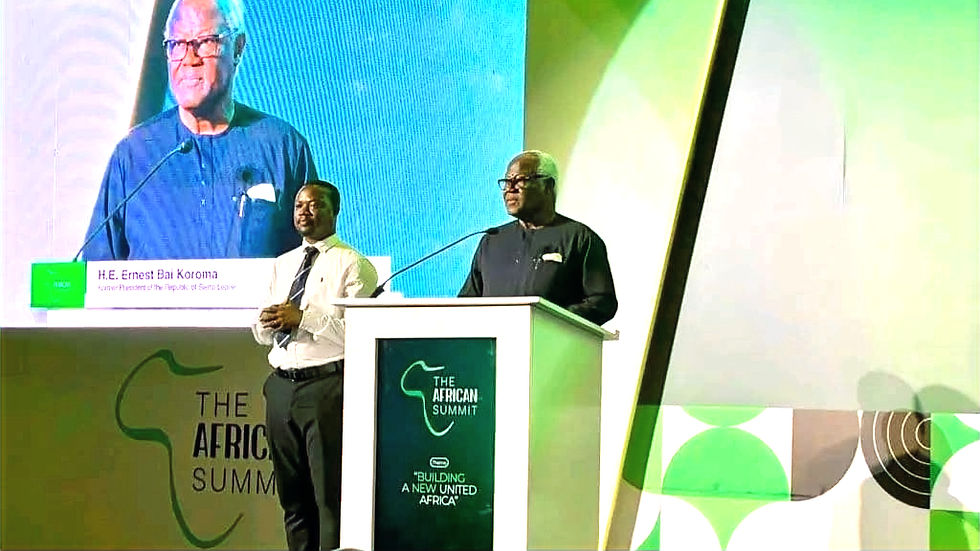
Former President of Sierra Leone, H.E. Dr. Ernest Bai Koroma, asserted that the achievement of African unity hinges upon the political will and determination demonstrated by the continent's leaders and citizens. He made these remarks while delivering a guest address at the African Summit in Accra, themed "Building a New United Africa," where he discussed "The United States of Africa: A Myth or Reality?"
Dr. Koroma traced the historical imperative for African unity back to the Pan-African movement championed by Ghana’s inaugural President, Kwame Nkrumah, framing continental integration as a necessary response to the colonial fragmentation imposed by the 1884–85 Berlin Conference. He argued that the artificial borders created during this era left African states susceptible to external influence and exploitation.
The momentum for unity, he noted, advanced through subsequent Pan-African congresses and culminated in the establishment of the Organization of African Unity (OAU). This period saw African leaders championing shared institutions as a means to collaboratively address poverty, conflict, and economic exploitation.
Dr. Koroma posited that the critical contemporary question for Africa is not the theoretical achievability of unity, but rather the collective political imagination and determination required to pursue it. He defined African unity as an iterative process, not a final state, demanding sustained political commitment, robust economic integration, and cultural affirmation.
He acknowledged significant impediments to integration, including Africa’s diverse ethnic, linguistic, and cultural landscape, economic disparities between nations, institutional capacity constraints, ongoing conflicts, and political instability in various regions. Furthermore, he highlighted the challenges facing regional economic communities and the continued exploitation of African divisions by global powers.
Despite these hurdles, Dr. Koroma advised African leaders to reject doubt, citing Europe’s post-conflict integration as proof that unity can coexist with diversity. He stressed that the summit should represent a transition from mere discussion to decisive action, advocating for implementation over continued dialogue.
Addressing the central theme, Dr. Koroma concluded that a United States of Africa remains a myth only if Africans choose to perceive it as such, but becomes a concrete reality when leaders and citizens exhibit the requisite political courage and an uncompromising vision for the future.
The African Summit, held in Accra, was collaboratively organized by the African Union Economic, Social and Cultural Council (AU ECOSOCC), Ghana’s Ministry of Foreign Affairs, and CENSADEV, convening policymakers, civil society leaders, and development stakeholders to define pathways toward deeper continental integration.


Comments